Adaptive Mediation and Conflict Resolution:
-
 Writen by
 - PublisherPalgrave Macmillan
- Year2022
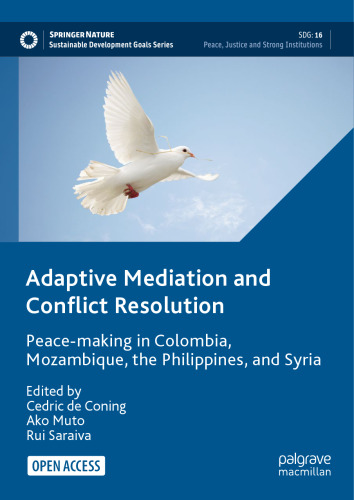
This book introduces adaptive mediation as a new approach to conflict resolution designed to address the failures of traditional, top-down liberal peacebuilding models. It argues that conventional mediation often imposes external frameworks that do not reflect local realities, leading to fragile or short-lived peace agreementsGrounded in complexity theory, adaptive mediation emphasizes flexibility, uncertainty management, and context-sensitive processes. Rather than imposing solutions, it promotes locally driven peace processes, where conflict parties themselves generate agreements based on their own socio-political realities.The book supports this framework through empirical case studies from Colombia, Mozambique, the Philippines, and Syria. These cases demonstrate that peace processes are more sustainable when mediators act as facilitators rather than decision-makers, and when local actors play a central role in negotiation and reconciliation. For the GRACE Repository, the book is highly relevant as it directly addresses sustainable peacebuilding, conflict transformation, and the importance of inclusive dialogue—key elements in preventing extremism and fostering long-term social cohesion.Strengths: Introduces a theoretically innovative model (adaptive mediation) grounded in real-world complexity. Strong empirical backing through diverse international case studies. Emphasizes local ownership, aligning with modern peacebuilding best practices. Bridges theory and practice, offering actionable insights for mediators and policymakers. Open access, increasing accessibility for researchers and practitioners. Limitations: Conceptual framework may be complex for beginners in conflict studies. Limited direct focus on ideological extremism or deradicalization programs. Case studies, while diverse, may not fully generalize to all conflict environments. 5. Relevance to Extremism Prevention, Rehabilitation, and Peacebuilding The book contributes significantly to preventing violent conflict escalation by promoting inclusive, locally grounded mediation strategies. By strengthening dialogue, reducing external imposition, and fostering ownership among conflict actors, it indirectly supports deradicalization and reintegration efforts. Its emphasis on self-organized peace processes and community participation is particularly valuable for rehabilitation frameworks and long-term peace sustainability—key objectives of the GRACE initiative.