
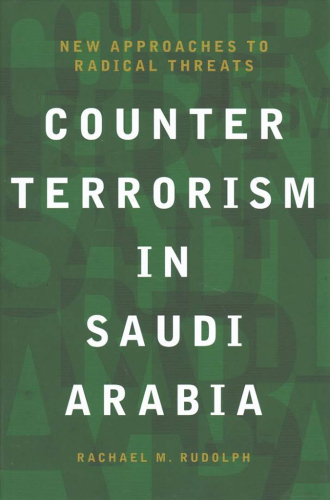
Counterterrorism in Saudi Arabia:
-
 Writen byRachael M. Rudolph
 - PublisherI.B. Tauris (London)
- Year2017
Counterterrorism in Saudi Arabia: New Approaches to Radical Threats offers one of the most detailed scholarly examinations of Saudi Arabia’s multi-layered response to jihadist extremism, particularly its internationally recognized rehabilitation and deradicalization initiatives. Rachael M. Rudolph traces how Saudi authorities combined hard security measures—such as intelligence operations, financial interdiction, and law enforcement—with softer mechanisms including religious dialogue, psychological counseling, family engagement, welfare support, and post-release reintegration incentives. The book is highly relevant to the GRACE Repository because it directly addresses rehabilitation-oriented counterterrorism, demonstrating how non-coercive, inclusion-based strategies can weaken extremist narratives and reduce recidivism. By emphasizing ideological disengagement, social belonging, and economic stability, the work aligns strongly with GRACE’s mission of moderation, coexistence, community engagement, and sustainable peace, while also providing a rare state-level case study where rehabilitation is treated as a core pillar rather than a peripheral add-on to counterterrorism policy.The book’s principal strength lies in its balanced and nuanced treatment of hard and soft counterterrorism tools, avoiding purely securitized narratives and foregrounding rehabilitation as a strategic necessity. Its empirical depth and policy-level insight make it especially useful for practitioners and researchers working on deradicalization programs. A minor limitation is that the analysis is largely state-centric, with limited exploration of independent civil society actors or comparative non-Gulf cases. Nevertheless, its detailed documentation of psychological, religious, and social reintegration mechanisms makes it one of the strongest GRACE-aligned case studies available.