
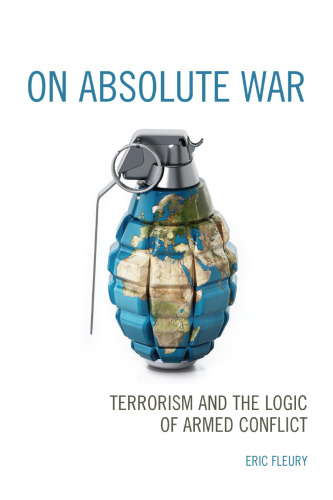
On Absolute War:
-
 Writen byEric Fleury
 - PublisherLexington Books
- Year2019
This book develops a Clausewitzian theoretical framework to explain terrorism as a strategic form of warfare rather than an aberrational or purely criminal phenomenon, arguing that terrorist groups mimic the logic of war as defined in On War. Through a close reading of Clausewitz and a rich set of historical case studies—from the Fenian Dynamite Campaign to Al Qaeda and ISIS—Fleury illustrates how terrorists conceptualize victory, exploit political will, and engage state militaries through asymmetric methods that still follow rational patterns of armed conflict. The analysis illuminates how the U.S. “War on Terror” often misunderstood the strategic logic of its adversaries by refusing to treat them as combatants engaged in political struggle, leading to impractical expectations of decisive military victory. The book’s relevance today is significant: contemporary terrorism continues to blend irregular warfare, political messaging, and hybrid tactics, while governments still struggle to align military operations, legal frameworks, and strategic objectives. In an era of decentralized jihadist networks, far-right violence, and evolving insurgent tactics, Fleury’s Clausewitzian lens offers a timely conceptual tool for understanding the strategic behavior of non-state violent actors.Fleury’s integration of Clausewitz with terrorism studies is a major strength, offering a rare theoretical depth that ties terrorism to broader war logic instead of treating it as an exceptional category. The book’s case studies enrich the argument and demonstrate a solid grasp of strategic behavior across time periods. Its main limitation lies in its heavy theoretical focus, which may reduce accessibility for policy practitioners seeking operational guidance, and its reliance on Clausewitz may underrepresent alternative theoretical traditions such as social movement theory, psychology of extremism, or network analysis. Nonetheless, the work remains an intellectually rigorous contribution that expands conceptual clarity around terrorism as a strategic enterprise.An important and theoretically strong book that reframes terrorism within the logic of armed conflict, making it highly suitable for academic collections in security studies, terrorism studies, and strategic theory. Its Clausewitz-based framework offers valuable insights for scholars, analysts, and advanced students, and it merits inclusion in any comprehensive repository on terrorism and armed conflict.