
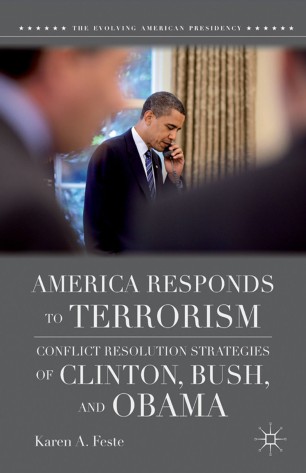
America Responds to Terrorism:
-
 Writen byKaren A. Feste
 - PublisherPalgrave Macmillan
- Year2011
This book examines how three successive U.S. presidents—Clinton, Bush, and Obama—framed terrorism and implemented conflict resolution strategies in response to threats from al Qaeda and other Islamic extremist groups. Using a frame theory approach, Feste analyzes presidential statements, policies, and strategic choices to identify patterns in conflict avoidance, fight-to-win approaches, and problem-solving strategies. The work is highly relevant to contemporary terrorism studies and U.S. foreign policy, as it demonstrates how leadership styles, strategic framing, and decision-making processes influence national security outcomes. Scholars, policymakers, and practitioners can draw lessons on the effectiveness of presidential conflict resolution in counterterrorism, the management of public perception, and the shaping of both domestic and international security strategies in response to evolving threats.The book’s strengths include its rigorous application of frame theory, structured comparative analysis across three presidencies, and integration of political and security dimensions. The systematic examination of speeches, policies, and crisis responses provides deep insight into presidential decision-making and counterterrorism frameworks. Limitations include a focus primarily on U.S. policy without extensive engagement with global comparative cases, and the analysis is largely qualitative, which may limit empirical generalizability. Nevertheless, it offers a nuanced understanding of leadership and strategy in responding to terrorism.A substantial and insightful contribution to U.S. counterterrorism and presidential studies, particularly for understanding strategic responses to terrorism across different administrations. Highly recommended for repositories focused on terrorism, political leadership, and international security.