
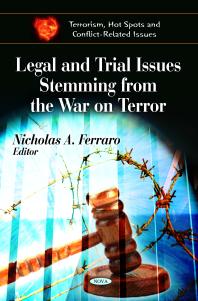
Legal and Trial Issues Stemming from the War on Terror
-
 Writen byNicholas A. Ferraro
 - PublisherNova Science Publishers, Incorporated
- Year2010
This book examines the complex legal and procedural challenges that emerged during the United States’ War on Terror, focusing particularly on the detention and trial of alleged enemy combatants. It provides a detailed analysis of Guantanamo Bay detention policies, congressional debates during the 111th Congress on transferring detainees, and the legal controversies surrounding prosecutorial choices—whether terrorism suspects should be tried in federal court or through military commissions under the Military Commissions Act. The text highlights differences in evidentiary standards, constitutional protections, jurisdictional authority, and procedural safeguards between the two systems. Its relevance remains strong today, as nations continue grappling with legal norms in counterterrorism operations, balancing national security with human rights, adapting legal processes to non-state armed groups, and negotiating international expectations regarding detentions, due process, and extraterritorial jurisdiction—issues that persist in current counter-extremism and post-9/11 legal landscapes.The book is a rigorous and policy-focused overview of the legal dilemmas produced by post-9/11 counterterrorism practices. Its main strength lies in its clear explanation of statutory developments, the structure of military commissions, and the nuances of federal criminal procedure in terrorism cases. It serves as an excellent legal primer for scholars, policymakers, and practitioners seeking an institutional and legislative perspective. However, it is largely descriptive, offering minimal critique of constitutional ramifications, international humanitarian law compliance, or comparative global jurisprudence. The absence of deeper theoretical engagement limits its analytical depth. Moreover, as a pre-2010 study, it does not cover subsequent legal evolutions such as NDAA 2012 detention provisions, reforms to military commissions, Supreme Court rulings, or shifting approaches to domestic terrorism. Despite this, the book stands as a valuable reference on the foundational legal architecture of the War on Terror.A well-structured and informative resource that effectively captures key legal debates surrounding detainee trials, military commissions, and the constitutional tensions produced by U.S. counterterrorism policy. It remains an important work for understanding the roots of current legal frameworks, even though it predates later reforms and contemporary legal challenges.