

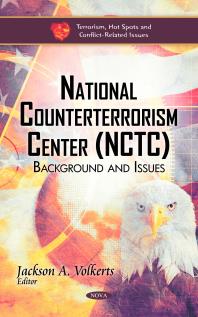
National Counterterrorism Center (NCTC): Background and Issues :
-
 Writen byJackson A. Volkerts
 - PublisherNova Science Publishers, Incorporated
- Year2011
This book provides a comprehensive institutional, legislative, and operational overview of the U.S. National Counterterrorism Center (NCTC), tracing its evolution from post-9/11 reforms to its role within the Office of the Director of National Intelligence. It explains how the NCTC integrates intelligence from multiple agencies, produces strategic threat assessments, prepares daily briefings, and supports federal counterterrorism planning at the national level. The text also outlines congressional concerns, interagency coordination challenges, and developing policy issues that shape the center’s performance. In today’s world of decentralised extremist networks, online radicalisation, AI-enabled threats, and hybrid warfare, the NCTC model remains highly relevant as governments seek integrated intelligence hubs with real-time data capability. The book’s analysis of bureaucratic coordination, policy oversight, and interagency information-sharing continues to mirror contemporary debates about national preparedness, cyber-terrorism, and the evolution of centralized counterterrorism institutions.The book excels in providing clear, accessible, and well-structured documentation of the NCTC’s formation, mandate, and organisational architecture. It is especially valuable for students and researchers needing a factual, policy-oriented primer on how U.S. counterterrorism bureaucracy functions. Its strength lies in its synthesised presentation of legislative history, intelligence coordination mechanisms, and the NCTC’s analytical outputs. However, the text is descriptive rather than analytical, offering limited theoretical engagement with counterterrorism studies, organisational sociology, or security governance frameworks. It also lacks critical perspectives on civil liberties, oversight deficits, or interagency failures—issues widely discussed in later scholarship. The book would have benefitted from comparative analysis with international counterterrorism centers and from updated discussion reflecting post-2011 threat evolution. Nevertheless, its factual clarity and policy relevance make it a strong foundational resource.A focused, authoritative, and well-structured introduction to the National Counterterrorism Center, highly useful for policy researchers, students of intelligence studies, and those examining U.S. counterterrorism architecture. While somewhat dated in light of post-2011 developments, it remains an essential reference for understanding institutional design and interagency intelligence integration.