
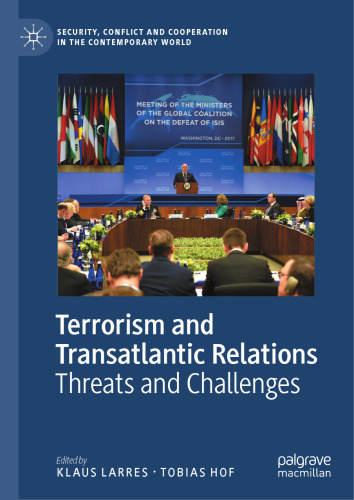
Terrorism and Transatlantic Relations: Threats and Challenges (1st edition)
-
 Writen byKlaus Larres; Tobias Hof (eds.)
 - PublisherPalgrave Macmillan
- Year2022
This edited volume examines the evolution of transatlantic terrorism policy from the late 1970s to the post-9/11 era, exploring how the United States and Europe have aligned or diverged in their responses to international terrorism. Bringing together multidisciplinary perspectives from history, political science, psychology, law, and security studies, the book analyses the shifting nature of terrorist threats, including the rise of Islamist terrorism, ISIS’s use of social media, al-Qaeda’s persistent global networks, and the increasing salience of right-wing extremism across Western societies. Several chapters trace the roots of modern terrorism, assess how political violence interacts with legitimacy struggles, and evaluate the impact of domestic, transnational, and digital radicalisation. The volume highlights the ongoing challenges of coordinating transatlantic strategies in light of political polarization, evolving extremist ideologies, and cybersecurity vulnerabilities. Its relevance to the current era is substantial, as it offers insights into how shared democratic alliances can respond to decentralized, hybrid, and tech-enabled terrorism while maintaining political cohesion; it also informs community engagement mechanisms by underscoring the need for harmonized counter-narratives, cross-border intelligence sharing, and preventative interventions that integrate social, psychological, and legal perspectives.This work is a highly valuable and comprehensive contribution to the study of terrorism and transatlantic security cooperation. It successfully bridges historical context and contemporary analysis, making it an essential reference for scholars and policymakers concerned with evolving global threats.The book’s major strength lies in its interdisciplinary construction and its ability to connect historical developments with present-day threats. The editors have curated contributions that collectively provide a panoramic understanding of terrorism’s evolution across the Atlantic world, while also revealing structural tensions within the US–European security partnership. Its coverage of jihadist networks, far-right extremism, online propaganda, terrorism financing, and cybersecurity reflects an ambitious scope that enriches the field. A notable strength is its historical depth, which situates current extremist trends within long-term political and ideological trajectories. However, as with many edited volumes, the quality and analytical cohesion vary between chapters, and some sections rely more on descriptive historical narrative than on forward-looking policy evaluation. Compared with similar works on transatlantic terrorism, this volume stands out for its range of disciplinary voices, though it may be less theoretically unified than single-author monographs. Nevertheless, its depth, breadth, and contemporary relevance make it a significant scholarly resource.