
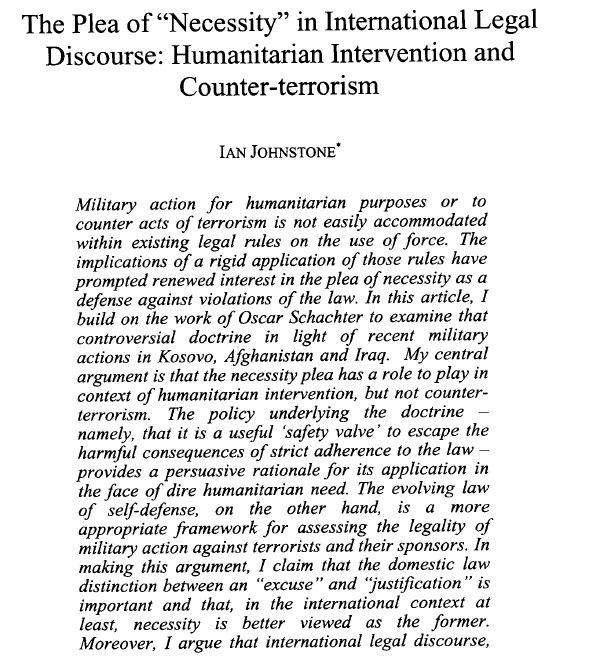
The Plea of “Necessity” in International Legal Discourse:
-
 Writen byIan Johnstone
 - PublisherColumbia University School of Law
- Year2004–2005)
Johnstone examines the plea of necessity as a potential justification or excuse for states’ use of force in cases where strict adherence to international law would result in grave harm — especially in humanitarian intervention and counter-terrorism contexts. Key arguments include: The doctrine of necessity my serve as a limited “safety valve” within international law when rigid application of the UN Charter’s rules on force would lead to moral absurdity or human catastrophe. Necessity may excuse humanitarian interventions like Kosovo (1999) when undertaken to prevent mass atrocities, but not justify counter-terrorist military actions, which fall better under the evolving law of self-defense. The distinction between “excuse” and “justification” is critical: necessity should be viewed as an excuse that preserves the law’s authority while allowing compassion for extreme circumstances. International law, despite its decentralization, operates through an interpretive community capable of nuanced moral and legal judgments on state actions.Current Relevance (2020s–2025) Contemporary significance: Highly relevant to debates about “Responsibility to Protect” (R2P) and state responses to terrorism outside traditional battlefields (e.g., Syria, Gaza, Ukraine). The distinction between humanitarian necessity and counter-terrorism justification continues to shape UN Security Council deliberations and ICJ reasoning. Academic influence: Often cited in international law scholarship discussing state responsibility, legality of humanitarian intervention, and legitimacy of force without UN authorization. The article remains a foundational piece connecting Oscar Schachter’s legal philosophy with modern debates about moral exceptions in law. Policy relevance: Frames how states justify interventions or military actions under “exceptional circumstances.” Informs current legal debates over sovereignty vs humanitarian obligation.