

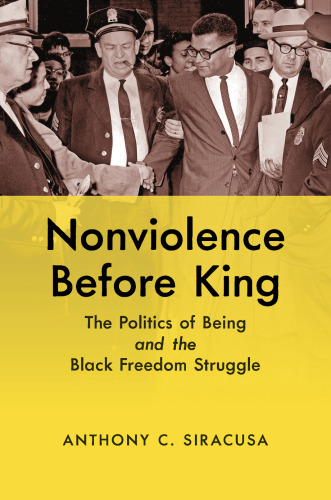
Nonviolence before King:
-
 Writen byAnthony C. Siracusa
 - PublisherUniversity of North Carolina Press
- Year2021
Anthony C. Siracusa’s Nonviolence before King challenges the widespread belief that Martin Luther King Jr. was the singular founder of nonviolent protest in the American civil rights movement. Instead, the book traces the intellectual, religious, and political genealogy of nonviolence through the lives and work of earlier leaders such as Howard Thurman, Pauli Murray, Bayard Rustin, and James M. Lawson Jr. By exploring these figures, Siracusa shows how nonviolence was not merely a tactic but a “politics of being”—a way of life grounded in dignity, community, and prophetic religious imagination. The book highlights how Black activists reframed nonviolence as both a moral and practical strategy against systemic racism, “Jane Crow” sexism, and state-sanctioned violence. Through a careful balance of biography, theology, and political analysis, Siracusa recovers a broader history of how grassroots Black leaders laid the foundation for King’s activism and for future struggles for justice.This book is deeply relevant to GRACE’s mission as it demonstrates how nonviolence can be cultivated as a life practice and collective political strategy—a crucial lesson for societies facing extremism and intolerance today. Community engagement mechanisms include: • Youth Empowerment Programs: Using the lives of Rustin, Murray, and Lawson as case studies for training in nonviolent resistance. • Educational Integration: Curriculum design in peace studies, political science, and African American history. • Workshops on Faith and Peace: Drawing from Thurman’s and Lawson’s religious grounding of nonviolence. • Dialogue Platforms: Applying lessons from the U.S. Black freedom struggle to global struggles against terrorism, radicalization, and racial or religious discrimination.Nonviolence before King is a critical historical recovery of the people and ideas that shaped nonviolent action before it was popularized by Martin Luther King Jr. It strengthens the repository’s mission by showing that nonviolence is a collective, diverse, and resilient practice rather than the legacy of one individual.


