
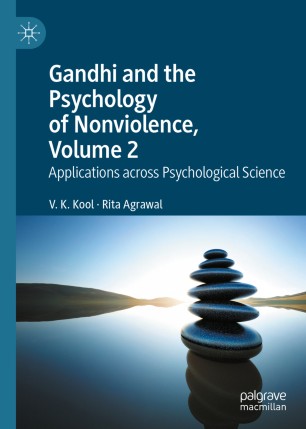
Gandhi and the Psychology of Nonviolence, Volume 2:
-
 Writen byV. K. Kool, Rita Agrawal
 - PublisherPalgrave Macmillan
- Year2020
This second volume builds upon the authors’ earlier work (Gandhi and the Psychology of Nonviolence, Vol. 1) by applying Gandhian principles of ahimsa (nonviolence) to a wide spectrum of psychological sciences. Kool and Agrawal explore how Gandhi’s ethical and spiritual framework can inform contemporary psychology across diverse fields—community psychology, environmental psychology, organizational behavior, pedagogy, moral psychology, and even the psychology of technology. The book emphasizes that in the era of the Anthropocene, marked by ecological crises and social fragmentation, Gandhi’s legacy of nonviolent consciousness and noospheric thinking can offer sustainable solutions. The chapters connect Gandhian thought to pressing issues such as climate change, moral decline, workplace stress, religious conflict, and the psychological impacts of modern technology. This volume thus represents both a theoretical framework and a practical application of nonviolence in 21st-century psychological science. The work is deeply relevant in today’s age of climate emergencies, radicalization, and socio-psychological stress. By linking Gandhian philosophy to multiple branches of applied psychology, it creates a pathway for rehabilitation, community resilience, and interfaith harmony, which aligns with GRACE’s mission. Community Engagement Mechanisms include: • Applying nonviolent psychological models in community healing and peacebuilding initiatives. • Introducing Gandhian pedagogy in schools and universities for character building and conflict resolution. • Using environmental psychology through Gandhi’s lens to strengthen ecological responsibility. • Promoting organizational well-being and nonviolent leadership models in workplaces. • Supporting interfaith and moral psychology projects inspired by Gandhian principles. This book is an authoritative and interdisciplinary contribution that bridges Gandhi’s nonviolence with modern psychological science. It is both academically rigorous and practically adaptable, making it highly suitable for the GRACE Repository. Strengths: • Integrates psychology with Gandhian philosophy in a novel, research-grounded way. • Covers wide-ranging applied fields (community, environment, education, organization, religion). • Connects Gandhian nonviolence to urgent global challenges in the Anthropocene. Limitations: • Dense academic style may limit accessibility for general audiences. • More empirical case studies could strengthen practical applications.