

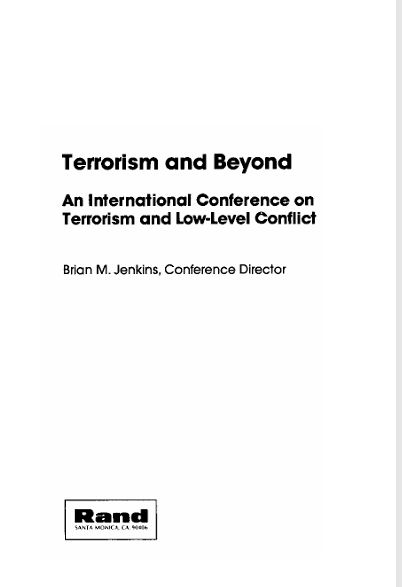
Terrorism and Beyond:
-
 Writen byBrian M. Jenkins (Editor)
 - PublisherPublished by the RAND Corporation
- Year1982
Terrorism and Beyond compiles the proceedings of a pivotal 1980 conference organized by the RAND Corporation, bringing together scholars, policymakers, and security experts to examine the evolving nature of terrorism and low-intensity conflicts. The conference addressed four primary areas: the terrorist environment, the terrorist mindset, government responses, and projections for the future trajectory of terrorism. Discussions delved into the motivations and behaviors of terrorist groups, the strategic and tactical approaches employed by insurgents, and the challenges faced by states in countering these threats. The proceedings offer a comprehensive analysis of the complexities surrounding low-level conflicts and provide foundational insights into the dynamics of modern terrorism The insights presented in Terrorism and Beyond remain highly pertinent in the contemporary context of global security challenges. The examination of non-state actors and the strategies they employ continues to inform current counterterrorism and counterinsurgency operations. Community engagement mechanisms, such as fostering dialogue between affected communities and security forces, promoting local governance, and addressing socio-economic grievances, are essential components in mitigating the impact of low-level conflicts and building resilience against radicalization.Terrorism and Beyond stands as a seminal work in the field of terrorism and conflict studies. Its comprehensive analysis of the multifaceted nature of terrorism and low-level conflicts provides valuable perspectives for scholars, policymakers, and practitioners. The proceedings offer enduring lessons on the complexities of modern warfare and the necessity for multifaceted approaches in addressing security threats.The strength of this volume lies in its interdisciplinary approach, integrating perspectives from political science, military strategy, and sociology to provide a holistic understanding of terrorism and low-intensity conflicts. The contributions from various experts offer diverse viewpoints, enriching the discourse on counterterrorism strategies and conflict resolution. However, the publication's age may limit its applicability to contemporary issues, as the landscape of terrorism has evolved significantly since its publication. Nonetheless, the foundational concepts and analyses presented continue to serve as a valuable reference for current studies and policy development.


