

Routledge Handbook of the Global South in Sport for Development and Peace
-
 Writen byBilly Graeff, Simona Šafaříková, Lin Cherurbai Sambili-Gicheha
 - PublisherRoutledge
- Year2024
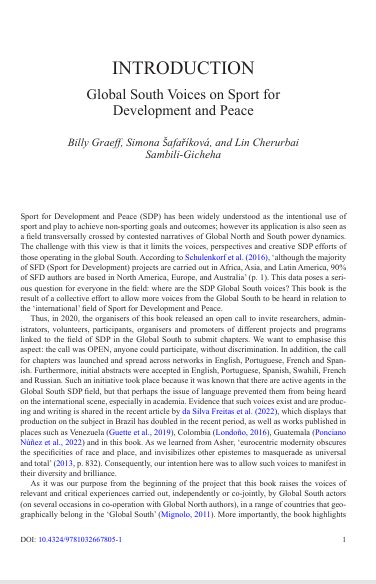
The Routledge Handbook of the Global South in Sport for Development and Peace presents a comprehensive examination of Sport for Development and Peace (SDP) through the lens of Global South perspectives. Edited by Graeff, Šafaříková, and Sambili-Gicheha, the volume compiles original research and case studies from Africa, Asia, South America, North America, and Oceania. It emphasizes locally-driven initiatives that utilize sport to address social issues such as conflict, gender inequality, migration, and youth disenfranchisement. The book critiques traditional top-down approaches and advocates for the inclusion of indigenous knowledge and practices in SDP programs. Contributors, predominantly from the Global South, offer insights into the challenges and successes of implementing sport-based interventions in diverse socio-political contexts.In a world grappling with complex challenges like armed conflict, displacement, and social inequality, this handbook underscores the transformative potential of sport as a tool for peacebuilding and development. Its focus on Global South narratives provides a counterbalance to dominant Western discourses, promoting a more inclusive and equitable approach to SDP. Community engagement mechanisms highlighted in the book include participatory program design, capacity building for local leaders, and fostering cross-cultural partnerships that enhance the sustainability and impact of SDP initiatives.The Routledge Handbook of the Global South in Sport for Development and Peace is a seminal work that enriches the field of SDP by amplifying underrepresented voices and perspectives. Its interdisciplinary approach and diverse geographical coverage make it an indispensable resource for scholars, practitioners, and policymakers committed to leveraging sport for social change.This handbook's primary strength lies in its authentic representation of Global South experiences and methodologies in SDP. By foregrounding local knowledge and practices, it challenges conventional paradigms and offers innovative solutions to entrenched problems. The book's scholarly rigor is complemented by its accessibility, making it suitable for both academic and practical applications. However, the extensive geographical scope may result in some thematic areas receiving less in-depth exploration. Nonetheless, the volume's contributions significantly advance the discourse on SDP and its role in fostering sustainable development and peace.


