
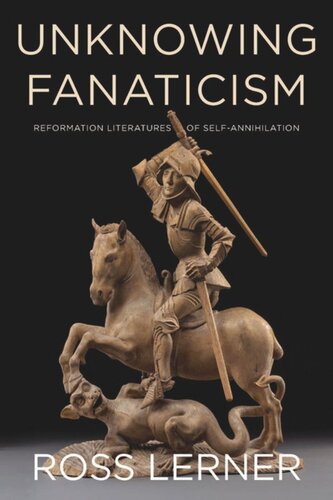
Unknowing Fanaticism:
-
 Writen byRoss Lerner
 - PublisherFordham University Press
- Year2019
Unknowing Fanaticism by Ross Lerner reinterprets the literary and political tensions of the European Reformation, exploring how religious fanaticism was not simply condemned, but also explored as a complex poetic and epistemological issue. The book investigates how early modern thinkers like Martin Luther and John Locke weaponized the term “fanatic” to delegitimize dissent, while poets such as John Donne, John Milton, and Edmund Spenser responded not by rejecting fanaticism, but by examining its mystical, self-destructive, and prophetic dimensions. Lerner posits that these poets were deeply engaged with the notion of unknowing—the idea that fanaticism both challenged and enriched the poetic imagination. Fanaticism, rather than being a merely violent or anti-rational force, is presented here as a literary and political site of crisis, capable of disrupting assumptions about human and divine agency, individuality, and collective identity. Though rooted in Reformation-era history, this book offers timely insights into how fanaticism continues to be used to police ideological boundaries, particularly in the post-9/11 discourse, where labeling dissent as “fanatic” often justifies suppression or violence. The work underscores the rhetorical nature of fanaticism, showing that even historically, it was a constructed term shaped by power. The study promotes critical engagement by helping readers recognize how language and literature have historically framed—and sometimes undermined—the legitimacy of ideological others. As such, the book is useful for modern community educators and scholars examining how extremist identities are both constructed and confronted through art, literature, and law. It supports educational community engagement by encouraging students and scholars to interrogate inherited narratives about extremism and recognize the complexity of ideological conflicts across time.Though rooted in Reformation-era history, this book offers timely insights into how fanaticism continues to be used to police ideological boundaries, particularly in the post-9/11 discourse, where labeling dissent as “fanatic” often justifies suppression or violence. The work underscores the rhetorical nature of fanaticism, showing that even historically, it was a constructed term shaped by power. The study promotes critical engagement by helping readers recognize how language and literature have historically framed—and sometimes undermined—the legitimacy of ideological others. As such, the book is useful for modern community educators and scholars examining how extremist identities are both constructed and confronted through art, literature, and law. It supports educational community engagement by encouraging students and scholars to interrogate inherited narratives about extremism and recognize the complexity of ideological conflicts across time.Ross Lerner’s book is a brilliant blend of literary scholarship and historical-political analysis, offering a radical reevaluation of religious fanaticism as both a cultural category and a poetic problem. It opens up innovative paths for understanding radicalism and its relationship to aesthetics, authorship, and political control. Its depth of analysis and relevance to the conceptual framing of fanaticism make it a strong candidate for inclusion in any counter-extremism repository rooted in interdisciplinary understanding.