
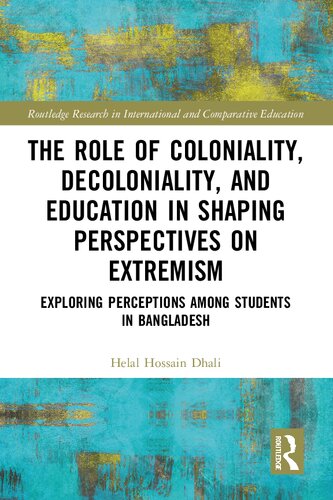
The Role of Coloniality, Decoloniality, and Education in Shaping Perspectives on Extremism
-
 Writen byHelal Hossain Dhali
 - PublisherRoutledge (inferred from ISBN prefix 978103)
- Year2024
This book provides a timely and critical exploration of how coloniality and decoloniality continue to shape understandings of extremism and violence, particularly through the lens of education systems. Helal Hossain Dhali presents an interdisciplinary approach that combines political theory, postcolonial studies, and pedagogy to examine how legacy structures of colonial power frame global discourses on radicalization and terrorism. Key themes include: • Colonial Legacy and Modern Narratives: The book argues that the way extremism is framed in education and policy is still influenced by Eurocentric knowledge systems and colonial-era definitions of the "Other." • Decolonial Pedagogy: Dhali proposes that truly addressing extremism requires a decolonial educational approach that includes non-Western epistemologies and prioritizes historical justice. • Case Studies: While theoretical, the book also includes examples from the Global South (particularly South Asia and Africa) to illustrate how education either perpetuates or challenges extremist ideologies. • Critical Engagement: The book challenges both liberal and conservative narratives on counterterrorism and calls for a reevaluation of global education curricula to include voices marginalized by colonial histories. In the contemporary global landscape—marked by increasing polarization, identity-based conflicts, and the resurgence of far-right and extremist ideologies—The Role of Coloniality, Decoloniality, and Education in Shaping Perspectives on Extremism by Helal Hossain Dhali offers a highly relevant and critical intervention. As societies grapple with the root causes of radicalization, Dhali's work underscores the importance of re-examining the colonial foundations of knowledge systems, especially in how extremism is defined, taught, and responded to globally. This relevance is heightened in: • Post-conflict societies seeking truth and reconciliation. • Global education reforms, where curricula still reflect colonial frameworks. • Youth radicalization debates, particularly in marginalized or postcolonial contexts. • Policy and peacebuilding forums, where narratives are often shaped by Western-centric security paradigms. By situating extremism within a broader history of power, exclusion, and epistemic violence, the book invites a shift from securitized counterterrorism approaches to more inclusive, culturally aware, and historically informed frameworks. This book promotes community engagement in the following ways: 1. Empowering Marginalized Voices: By challenging dominant narratives on extremism and incorporating non-Western epistemologies, it creates space for communities historically labeled as “suspect” or “at-risk” to reclaim their agency and tell their own stories. 2. Educational Reforms and Dialogue: It encourages institutions and educators to revise curricula to reflect pluralistic histories—thus fostering critical thinking, mutual respect, and intercultural dialogue among students. 3. Decolonial Community Action: Activists, NGOs, and local peacebuilders can draw from its framework to initiate grassroots campaigns that emphasize structural causes of violence, rather than simply behavioral ones. 4. Bridging Generational Gaps: By situating extremism within a historical context, the book can help elders and youth co-create narratives of peace and reform, reducing generational misunderstandings in communities. 5. Policy Advocacy: The work equips civil society actors and policymakers with alternative lenses to propose reforms in counter-extremism strategies, ensuring they are human rights-based and community-informed.