
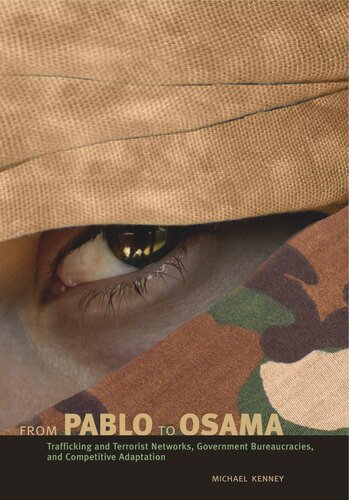
From Pablo to Osama:
-
 Writen byMichael Kenney
 - PublisherPenn State University Press
- Year2007
From Pablo to Osama" provides a comparative study of the methods and evolution of Colombian drug-smuggling enterprises and terrorist networks, specifically focusing on organizations like al-Qaeda. The book explores how these illicit enterprises and extremist groups adapt and evolve, making them increasingly difficult to dismantle. Michael Kenney draws upon extensive research, including interviews with former drug traffickers and other hard-to-reach informants, to reveal how both drug traffickers and terrorists engage in competitive adaptation. By adapting and learning from their experiences, these groups make use of advanced tactics and knowledge to withstand law enforcement efforts. The book delves into how these organizations store knowledge, improve their practices, and build skills that ultimately make them resilient in the face of counterterrorism and anti-trafficking efforts. Relevance with the Current Era along with Community Engagement Mechanism: This book remains highly relevant today as the nexus between drug trafficking and terrorism continues to fuel global instability. The methods of adaptation and competitive survival employed by both drug cartels and terrorist groups are pivotal in understanding modern terrorism and violent extremism. In terms of community engagement, this book underscores the necessity of comprehensive strategies in counterterrorism that account for the adaptive capabilities of such groups. It highlights the importance of strengthening law enforcement systems, enhancing intelligence sharing, and addressing the root causes of extremism in local communities. By understanding how these networks evolve, governments and communities can better prepare to prevent and respond to the threats posed by both organized crime and terrorism.The book provides a crucial understanding of the dynamics between criminal organizations and terrorist groups, offering valuable insights into how they evolve and adapt in response to law enforcement and counterterrorism strategies. It serves as a critical resource for those involved in combating transnational crime and terrorismThis work is highly analytical, with a focus on the intersection between organized crime and terrorism. It is well-researched, presenting data from interviews and case studies to support its thesis. The interdisciplinary approach that includes insights from criminology, political science, and security studies enhances its value. However, its focus on the evolution of illicit networks may be too specialized for general readers but highly valuable for those working in counterterrorism, law enforcement, and security policy