
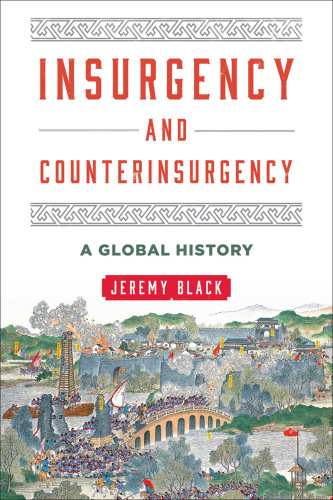
Insurgency and Counterinsurgency:
-
 Writen byJeremy Black
 - PublisherRowman & Littlefield Publishers
- Year2016
Jeremy Black's Insurgency and Counterinsurgency: A Global History provides a comprehensive overview of insurgencies and counterinsurgencies from a global perspective, reaching back to antiquity and stretching into the modern-day conflicts in Iraq and Afghanistan. Black moves beyond the traditional Western-centric narratives and contextualizes insurgency within a global framework. The book explores the historical roots of insurgencies and the evolution of state responses to them, from pre-modern states to modern powers, with a focus on the influence of military strategies, political ideologies, and technological advancements. Through a series of thematic and chronological narratives, Black highlights insurgencies across various regions, including China, Africa, and Latin America, exploring the unique military and political dimensions of each. He investigates the key lessons learned, how they were applied, and the broader impacts on statecraft and global power dynamics. Relevance with the Current Era along with Community Engagement Mechanism: This book remains highly relevant to contemporary discussions surrounding insurgencies and counterinsurgency efforts, especially in regions like the Middle East, Africa, and Asia. The global historical perspective allows for an in-depth understanding of the complex nature of insurgencies, which continues to shape international security policies and military strategies today. Community engagement mechanisms can be drawn from the lessons learned about how states, military forces, and civil populations interact in insurgency contexts. This resource can inform efforts in de-radicalization programs, conflict resolution, and peacebuilding initiatives, particularly in regions struggling with insurgency-related violence. Insurgency and Counterinsurgency: A Global History is a vital academic resource for understanding the evolution of insurgent movements and their countermeasures across diverse global contexts. Its comprehensive approach to the history of conflict provides a rich analytical framework for both scholars and practitioners in military strategy, political science, and international relations. Although its academic nature may limit accessibility for non-specialist readers, it serves as an indispensable text for those studying the theory and practice of insurgency and counterinsurgency. This book is especially useful for fostering a deeper understanding of the changing dynamics of warfare and state responses, making it highly suitable for educational and policy-related purposes.