
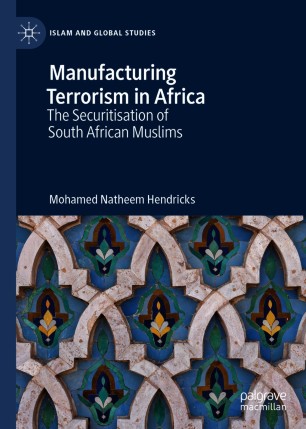
Manufacturing Terrorism in Africa:
-
 Writen byMohamed Natheem Hendricks
 - PublisherPalgrave Macmillan
- Year2020
This book employs Securitisation Theory to examine how Muslims have been framed as a security concern in Africa following the 9/11 attacks, which prompted the U.S. Global War on Terror (GWOT). It focuses on Africa's role in the GWOT and specifically investigates how Western-centric security narratives about Muslims have influenced South African security discourse in the post-apartheid era. The author argues that local media and think tanks have adopted, rather than critically assessed, debates underpinning policies like the GWOT. Notably, the book suggests that non-institutional actors have contributed to the securitisation of African Muslims by associating them with terrorism, thereby perpetuating knowledge that serves Western interests. In today's global landscape, understanding the dynamics of securitisation is crucial, especially regarding how specific communities are portrayed as security threats. This book sheds light on the processes that lead to such portrayals, offering insights into the implications for community relations and policy-making. Community Engagement and Attachment Mechanism: By critically analyzing the construction of security narratives, the book encourages a more nuanced understanding of Muslim communities in South Africa. This perspective can foster interfaith dialogue, reduce stigmatization, and promote peaceful coexistence. Manufacturing Terrorism in Africa provides a comprehensive analysis of the securitisation of Muslims in South Africa, highlighting the role of media and think tanks in shaping security discourses. Its critical approach offers valuable insights for scholars, policymakers, and practitioners interested in security studies, media representation, and community relations.