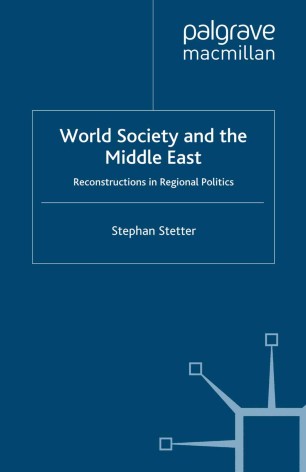
World Society and the Middle East: Reconstructions in Regional Politics
-
 Writen byStephan Stetter
 - PublisherPalgrave Macmillan
- Year2008
Stephan Stetter’s World Society and the Middle East examines the interplay between global societal changes and regional politics in the Middle East. The book explores how international influences and global norms interact with local traditions and political structures to reshape regional dynamics. Stetter provides a critical analysis of reconstruction processes in Middle Eastern politics, highlighting how transformations in world society impact governance, conflict resolution, and identity formation in the region. The work combines theoretical insights with empirical examples to uncover the complexities of political change in a rapidly globalizing world. The themes discussed in this book remain highly pertinent today as the Middle East continues to experience political instability, shifts in power, and the impact of globalization. With ongoing debates about sovereignty, democratization, and regional security, Stetter’s analysis offers valuable perspectives on how global societal trends influence local political landscapes. Its insights into the reconstruction of regional politics are particularly useful for understanding contemporary challenges and the evolving nature of international relations in the Middle East. World Society and the Middle East is a thought-provoking and analytically rigorous contribution to the fields of international relations and Middle Eastern studies. It provides an essential framework for examining how global forces and local factors converge to shape political realities, making it a significant resource for scholars, policymakers, and practitioners interested in the region. Evaluation of the Book Stetter’s work is theoretically rich and empirically grounded, effectively bridging global and regional analyses. The book’s interdisciplinary approach offers deep insights into the dynamics of power and identity in the Middle East. While its academic tone and complexity may present a challenge for non-specialist readers, the comprehensive examination of reconstructions in regional politics makes it an invaluable tool for advancing debates on peace, governance, and international relations in the modern era