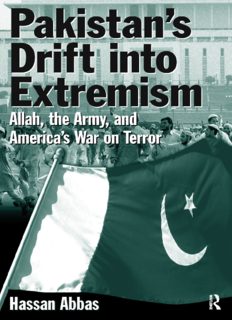
Pakistan’s Drift into Extremism: Allah, the Army, and America’s War on Terror
-
 Writen by Hassan Abbas
 - Publisher M. E. Sharpe
- Year 2005
Pakistan’s Drift into Extremism by Hassan Abbas explores the complex and nuanced political, military, and religious dynamics in Pakistan that have led the country toward increasing extremism, particularly in the context of its involvement in the War on Terror. The book examines the role of the Pakistani military, the rise of religious extremism, and the influences of both domestic and international politics. Through this analysis, Abbas highlights the way Pakistan's domestic policies, military strategies, and foreign relations have contributed to its struggle with radicalization. The work also critiques the role of the U.S. in shaping Pakistan's trajectory, offering a detailed look at the intersections of military power, religious ideology, and geopolitics. Indeed this book examines the rise of religious extremism in Pakistan and analyzes its connections to the Pakistan Army's policies and fluctuating U.S.-Pakistan relations. It includes profiles of leading Pakistani Jihadi groups with details of their origins, development, and capabilities based on interviews with Pakistani intelligence officials and militant leaders. The book contains new historical materials on Operation Gibraltar (the 1965 War with India), the conspiracy behind General Zia-ul-Haq's plane crash in 1988, a botched military coup by fundamentalists in 1993-4, and on how General Musharraf handled the volatile situation after the 9/11 attacks. In addition to a detailed profile of General Musharraf, the book evaluates India-Pakistan relations vis--vis the Kashmir conflict as well as Dr. A. Q. Khan's nuclear proliferation crisis, and also offers predictions for Pakistan's domestic and regional prospects. Current Era Relevance In the current era, Pakistan remains at the crossroads of extremism, military influence, and international involvement in counterterrorism efforts. The book remains highly relevant as it provides a historical lens through which to view Pakistan's ongoing struggles with radicalization. The topics of military influence, religious extremism, and foreign intervention are still central to discussions surrounding Pakistan's internal conflicts and its role in the global War on Terror. With the continuing global focus on counterterrorism and the shifting dynamics in the South Asian region, this book provides valuable insight into the structural and ideological factors that contribute to extremism, which can inform contemporary discussions and policy decisions. Rehabilitation Framework: The book doesn’t directly address rehabilitation methods but is crucial for understanding the root causes of extremism in Pakistan, providing a foundation for developing informed, context-specific rehabilitation programs that consider political, religious, and military influences.